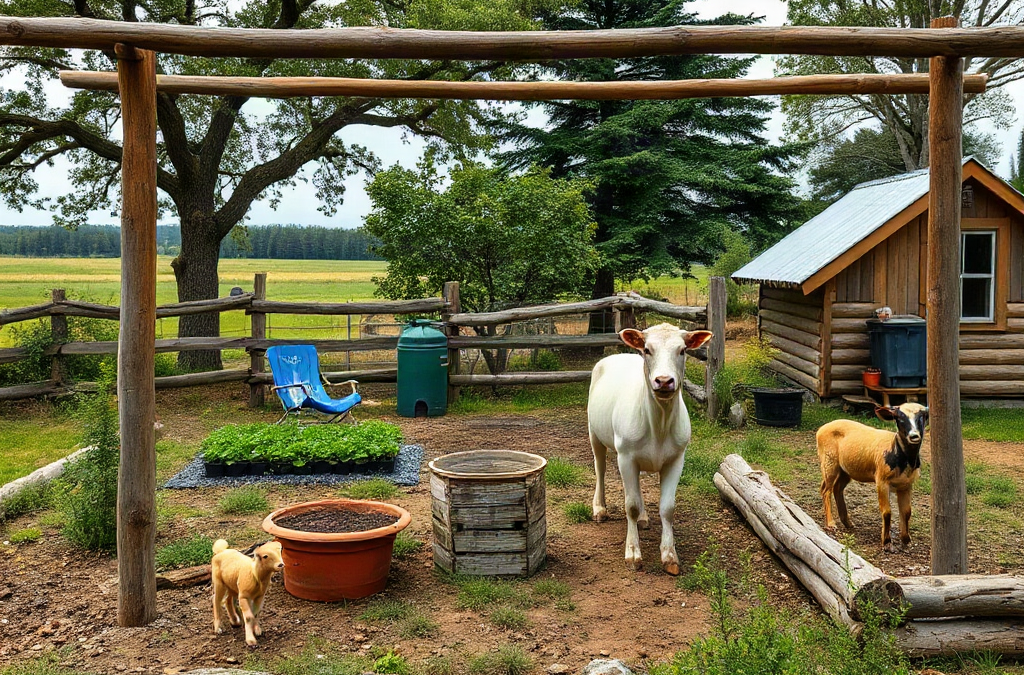
Designing Around the Real Limits of a Small Parcel
Small acreage becomes productive when the layout reduces wasted movement and gives each area a clear job. Before buying seed, poultry, or fencing, map sunlight, slope, drainage, existing trees, vehicle access, utility lines, and the distance between the house and proposed work areas. A quarter-acre lot with full sun, a reliable water connection, and good soil may produce more useful food than a larger parcel with dense shade, poor drainage, or no convenient access.
Divide the property into working zones rather than trying to place every homesteading activity everywhere. A garden, compost area, tool shed, washing station, orchard, and animal enclosure should relate to one another. Compost and harvested produce need short routes; manure should be close enough to use but far enough from living areas and food-washing surfaces to support good sanitation. A garden beside the kitchen may be more valuable than a larger garden at the far edge of the lot because frequent harvesting and watering actually happen.
Use a simple site plan that records seasonal changes. A spot that receives winter sun may be shaded by trees or buildings in midsummer, while spring drainage may reveal a wet area unsuitable for roots or permanent animal housing. Mark hose reach, gates, frost-sensitive spaces, and locations where rainwater naturally collects. These observations prevent expensive changes after beds, paths, or fencing are installed.
Land-use conflicts are more damaging on a small parcel than on a large one. Chickens may scratch through young crops, fruit trees may shade vegetables, and a shed placed in the best sunny location can permanently reduce food production. The better alternative to maximizing every inch is assigning priority areas: food near the house, infrastructure on already disturbed ground, and lower-priority uses in marginal spaces. A useful planning test is whether each proposed feature saves food costs, work time, water, or storage space. If it does none of these, postpone it.
Readers developing a site plan can compare their choices with the broader principles in Small-scale homesteading on limited acreage. Begin with a measured drawing, observe the property for a full season when possible, and leave room for paths, repairs, and expansion. A crowded plan may look efficient on paper but become frustrating when wheelbarrows, hoses, harvest baskets, or winter feed must pass through it.
Choosing Food Production With the Highest Return
Limited acreage favors crops that are costly to buy, frequently harvested, or especially fresh when picked at home. Salad greens, herbs, green onions, tomatoes, peppers, pole beans, cucumbers, and compact berries often make better use of a small garden than sprawling crops that are inexpensive or space-intensive. The best choices still depend on climate, sunlight, soil, household preferences, and the time available for watering and harvest.
Vertical growing changes the usable production area without increasing the ground footprint. Trellises can support pole beans, cucumbers, and some small-fruited squash, but they need sturdy anchoring and placement that does not shade shorter crops. Raised beds can improve access and drainage, although they are not automatically more productive; purchased soil, lumber, irrigation, and maintenance may cost more than an in-ground bed. Choose raised beds for poor soil, accessibility, or drainage problems rather than treating them as a requirement.
Succession planting is especially useful when space is scarce. A harvested radish or spring-green bed can be replanted with beans, fall greens, or a cover crop suited to the season. This approach requires a planting calendar and an honest estimate of when beds will be cleared. Overplanting too early creates crowded seedlings and wasted seed, while failing to replant leaves valuable soil unused during favorable weather.
Soil fertility should be managed as a system, not corrected with repeated guesses. A soil test can identify pH and nutrient conditions, while observation reveals compaction, standing water, erosion, and poor organic matter. Compost can improve structure, but fresh manure, contaminated materials, or excessive amendments can create sanitation and nutrient problems. Keep compost and manure management separate from areas where harvested foods are washed, and follow local agricultural guidance for safe handling.
A small orchard is a long-term investment rather than a quick food source. Dwarf or naturally compact fruit trees save space, but they still require pruning, pollination planning, pest observation, and protection from wildlife. If reliable annual harvests matter more than future potential, devote more space to perennial herbs, berries, and intensively planted vegetables first. Track what the household actually eats for one growing season; that record is more useful than copying a crop list designed for a larger farm.
Adding Animals Without Overloading the Land
Animals belong in a limited-acreage plan only when their housing, feed, manure, fencing, and daily care fit the property and household schedule. Chickens may provide eggs and manure on a modest footprint, while goats, sheep, and larger livestock generally demand more feed storage, stronger fencing, and management than a small parcel can comfortably provide. Local zoning, nuisance rules, predator pressure, and veterinary access must be checked before purchase.
Feed is the hidden land requirement. A small enclosure does not mean the animals are living from the property; many urban and suburban flocks depend almost entirely on purchased feed. That can still be a reasonable choice if eggs, companionship, or manure are the goal, but it should not be presented as full feed independence. Estimate annual feed use, bedding, replacement costs, and winter housing before deciding whether the output justifies the work.
Rotational access can reduce mud and vegetation loss, but it does not create unlimited carrying capacity. Moving poultry between several small runs may protect one area temporarily, whereas keeping birds on bare ground and simply adding more sections may spread, rather than solve, compaction and parasite problems. Ground cover, drainage, shade, secure night housing, and a plan for manure are more important than the number of paddocks.
Consider a household with a narrow backyard, a sunny side strip, and a detached shed. A dozen large birds could consume the available space, create odor near neighbors, and produce more eggs than the household can use. A smaller flock with secure housing, a covered run, and a defined compost routine may provide a better balance. Conversely, even a few birds are a poor fit if daily care, noise, or local restrictions are unacceptable. Garden-only production is often the wiser starting point.
Do not place animal housing at the lowest point of the property or beside a food-washing area. Runoff can carry manure into paths, beds, or drains, and wet bedding creates odor and health-management problems. Start with the smallest animal system that meets a stated purpose, monitor feed use and maintenance time for several months, and expand only when the routine remains manageable through bad weather.

Building Water, Storage, and Work Systems
Water access often determines whether a compact homestead succeeds. A garden that is easy to reach with a hose will receive more consistent care than one requiring repeated trips with watering cans. Check pressure, hose length, freeze protection, drainage, and the location of shutoff points before installing beds. Drip irrigation or soaker lines may reduce hand watering, but filters, connectors, and seasonal maintenance still matter.
Rainwater collection can supplement irrigation where permitted and properly managed, but it should not be treated as a guaranteed supply. Roof material, barrel capacity, mosquito control, overflow routing, winter conditions, and local rules affect its usefulness. Direct overflow away from foundations and animal areas. Stored water also becomes heavy and difficult to move, so place containers where gravity, hose access, and stable support work together.
Storage deserves the same planning attention as growing space. Canning equipment, jars, seed, feed, tools, fencing supplies, and harvested produce quickly fill a small property. A narrow, weather-protected shed with shelves may be more useful than a larger structure placed in productive sun. Keep frequently used tools at reachable height, separate chemicals or fuel from food areas, and provide ventilation for materials that may retain moisture.
Preservation choices should match the harvest volume and available time. Freezing herbs, drying some produce, fermenting appropriate foods, or storing firm roots may be more realistic than purchasing equipment for large-batch canning after one unusually productive season. Use tested food-safety instructions for preservation methods that involve sealed jars, fermentation, or low-acid foods; improvisation can create avoidable hazards.
A compact work system should make success visible. For each major activity, identify what to check and what failure looks like: wilted leaves and dry soil indicate missed irrigation; standing water indicates poor drainage; repeated tool searches indicate inadequate storage; muddy runs indicate overloaded ground or insufficient surfacing. Keep a seasonal maintenance list covering irrigation, fencing, pruning, compost, seed inventory, and winter protection. Good systems do not eliminate work, but they make problems apparent before they become expensive.
Frequently Asked Questions
What should be started first on limited acreage?
Start with a soil and sunlight assessment, dependable water access, a compact vegetable garden, and basic storage. Add animals only after the daily workload is proven manageable.
Can a small property provide complete food independence?
Complete independence is usually unrealistic because feed, grains, fuel, tools, and some seasonal foods may still be purchased. A focused goal such as fresh vegetables, eggs, herbs, or preserved produce is more measurable.
Which crops make sense in a small garden?
Choose crops that the household eats often and that are expensive, perishable, or notably better fresh, such as herbs, salad greens, tomatoes, peppers, beans, berries, and cucumbers.
Are chickens suitable for a small lot?
They may fit if zoning, noise, predators, housing, feed storage, manure handling, and daily care are acceptable. A smaller flock is often easier to manage than the maximum number the space can physically hold.
How can a small homestead reduce daily work?
Place high-use areas near the house, automate or simplify irrigation, store tools at the point of use, use sturdy paths, and keep a seasonal maintenance list. Design for bad weather rather than ideal conditions.
Conclusion
Limited acreage rewards selectivity rather than imitation of a large farm. Measure the site, protect sunny ground for crops, locate water and storage where they reduce walking, and choose food systems that match what the household actually consumes. Treat animals as a commitment involving feed, fencing, manure, and year-round care—not simply as a way to use spare space. Build one dependable garden or preservation routine before expanding into orchards, poultry, or additional infrastructure. Review the plan after a full season using records of harvests, costs, maintenance time, and recurring failures. The strongest small homestead is not the one with the most features; it is the one that produces useful food without exhausting the land, budget, or people managing it.