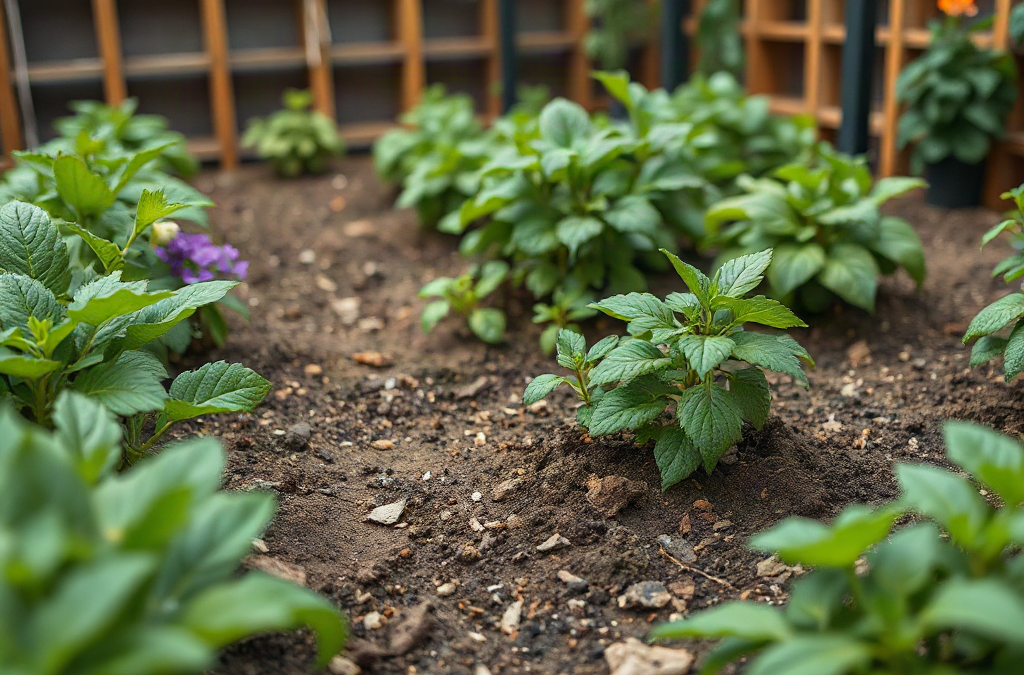
Square foot gardening for beginners works best when crop spacing is based on mature plant width: place 1, 4, 9, or 16 plants in each 12-inch square, with large crops receiving the most room. Center broccoli, cabbage, peppers, and similar plants individually; use four positions for leaf lettuce, nine for beets or spinach, and sixteen for radishes or small carrots. Trellised tomatoes, cucumbers, and peas belong along the bed’s north side so they do not shade shorter crops. Thin seedlings promptly, keep foliage from crowding neighboring squares, and widen spacing when varieties grow unusually large or airflow is limited.
How Does Square Foot Garden Spacing Work?
A square foot bed divides the growing area into 12-by-12-inch sections, but the grid is only a measuring tool. The useful decision is how many mature plants can occupy each section without competing excessively for light, root space, moisture, and moving air. A crop’s final width—not the size of its seed or transplant—determines whether the square holds one plant or a closely arranged group.
The common planting densities are 1, 4, 9, and 16 plants per square. One plant is centered in the square. Four plants form a two-by-two arrangement, with each plant roughly 6 inches from its neighbors. Nine plants form three rows of three at about 4-inch intervals. Sixteen plants form four rows of four at about 3-inch intervals. These measurements are center-to-center distances rather than empty gaps between leaves.
Adjacent squares share a boundary, so spacing must be considered across the grid lines. A cabbage centered 6 inches from one edge may eventually extend well into the next square. Filling that neighboring square with another broad crop creates congestion even though each square appears correctly planted on paper. Pairing the cabbage with radishes harvested early, compact herbs, or open space gives its outer leaves somewhere to extend.
Seed packets often list conventional row spacing and spacing after thinning. For a gridded bed, the thinning distance is generally the more useful starting point because traditional row gaps are partly intended for walking, cultivation, or equipment access. If a packet says to thin carrots to 3 inches apart, a four-by-four pattern fits the square. If lettuce should finish 6 inches apart, use four plants. Keep every foot out of the growing bed; compacted soil reduces the value of intensive spacing.
A common beginner mistake is sowing a pinch of seed at every marked position and leaving all successful seedlings in place. Several carrot or beet seedlings occupying one spot do not count as one plant. Their roots and foliage compete immediately, often producing undersized harvests. Cut extras at soil level once the strongest seedlings are identifiable. Pulling a dense cluster can disturb the plant being retained, especially in loose, newly watered soil.
Mark the grid physically with thin wood strips, string, or another durable divider. An actual grid makes center points easier to judge and prevents rows from drifting across boundaries. Correct spacing is working when plants develop evenly and neighboring leaves touch lightly without forming a permanently wet, tangled canopy. Persistent overlap, pale lower leaves, and difficulty reaching the soil are signs that the original layout was too ambitious.
Which Crops Fit at 1, 4, 9, or 16 Plants per Square?
The four standard densities provide a practical starting point, but variety descriptions still matter. Compact cultivars may fit the usual pattern comfortably, while sprawling or extra-large selections need more room. UF/IFAS Gardening Solutions identifies crops such as broccoli, kale, collards, cabbage, and sweet or white potatoes as plants that may require one per square, illustrating why mature form takes priority over seed size.
| Plants per square | Approximate spacing | Typical examples | Layout |
|---|---|---|---|
| 1 | 12 inches | Broccoli, cabbage, pepper, kale | One plant centered |
| 4 | 6 inches | Leaf lettuce, Swiss chard, basil | Two rows of two |
| 9 | 4 inches | Beets, spinach, bush beans | Three rows of three |
| 16 | 3 inches | Radishes, small carrots | Four rows of four |
Treat the examples as planning categories rather than promises for every cultivar. A full-size head lettuce usually needs more room than leaf lettuce harvested by removing outer leaves. Large storage carrots may perform better with wider spacing than short or slender carrots. Basil can become a substantial plant if repeatedly pinched and allowed to grow through summer, so four per square may become crowded where the growing season is long.
Some crops do not fit neatly into a single square. Zucchini and other summer squash can overwhelm several grid sections, even if the stem begins in one. Giving a squash a corner position allows its leaves to extend over a path rather than cover neighboring vegetables. A large indeterminate tomato may also require more than one square’s aboveground space, despite being trained vertically. Counting only the stem location ignores the canopy.
Succession planting changes how densely a square can be used over time. Fast radishes can occupy open positions around a young pepper because they may be removed before the pepper develops a wide crown. That is different from expecting both crops to remain at full size together. The calendar must support the combination: if cool weather delays the radishes or the pepper grows rapidly, competition may arrive before harvest.
Use this short placement check before sowing:
- Read the variety description: note mature spread, growth habit, and the packet’s final thinning distance.
- Choose the closest grid interval: use 12, 6, 4, or 3 inches rather than squeezing in an extra plant.
- Inspect neighboring squares: avoid placing two broad canopies directly against the same boundary.
- Plan the harvest stage: baby leaves leave sooner than full heads, while storage roots occupy the bed longer.
Dense planting is not automatically productive planting. Sixteen healthy radishes can use a square efficiently; sixteen cabbages cannot. The grid succeeds when it translates each crop’s biological size into a repeatable layout, not when every section contains the greatest possible number of stems.
Where Should Tall and Vining Crops Go?
Tall and trellised crops generally belong along the north side of a bed in the Northern Hemisphere, where their shadows are less likely to fall across shorter vegetables for much of the day. Garden orientation, buildings, fences, and nearby trees can alter that pattern, so observe the site before fixing a trellis permanently. In the Southern Hemisphere, the sun-facing relationship is reversed.
Peas, pole beans, cucumbers, and vining tomatoes use vertical space, but a trellis does not erase their need for root room or airflow. Place climbing crops in the row of squares nearest the support and tie or guide growth early. A cucumber vine left on the soil can cross several squares quickly, shading seedlings and making harvest difficult. Training it while the stem is flexible keeps the intended bed plan intact.
Growth habit changes spacing within the same crop. A determinate tomato forms a comparatively concentrated plant and may be supported with a cage, while an indeterminate tomato continues extending and needs regular tying and pruning decisions. A bush bean stays low and can be arranged as a block; a pole bean needs height and a support strong enough to carry mature vines. Labels such as “tomato” or “bean” are therefore too broad for reliable spacing.

Imagine a four-foot-wide bed with a trellis on its north edge. The trellis row could hold peas in spring, while southern squares contain lettuce, radishes, and beets. As warm weather arrives, the peas can be removed and a trained cucumber can take over part of the support. Placing the cucumber on the south edge instead would cast more shade into the bed and encourage vines to spill into the path unless they were redirected frequently.
Air movement deserves as much attention as sunlight. Leaves pressed tightly against a fence or layered through a crowded trellis dry slowly after rain or irrigation. Give the support enough clearance for access, direct water toward the soil, and remove damaged or heavily congested foliage when appropriate for the crop. More pruning is not a substitute for adequate spacing; stripping too much leaf area can expose fruit and reduce the plant’s capacity to grow.
Check vertical crops at least weekly during active growth. The layout is holding when vines remain on their support, shorter plants receive usable light, and fruit can be reached without breaking neighboring stems. If vines repeatedly escape, lower foliage stays damp, or a tomato fills the entire bed width, reduce the number of large plants next season rather than trying to force every canopy back into its assigned lines.
When Should You Adjust the Standard Spacing?
Standard spacing should be widened when mature varieties are large, sunlight is limited, airflow is poor, or the gardener cannot maintain steady watering and harvesting. Intensive beds place roots close together, so delays in irrigation or removal of mature crops have faster consequences than they do in a loose conventional row. The grid is a starting system, not a reason to disregard visible plant stress.
Climate influences canopy behavior. In a humid location, tightly overlapping foliage may remain wet for long periods, making wider spacing and careful crop placement sensible. In a hot, dry location, some leaf contact can shade the soil and slow surface evaporation, but crowding still cannot compensate for inadequate water. Irrigate deeply enough to moisten the active root zone and check the soil rather than assuming every square dries at the same rate.
Soil condition also limits how intensively a bed can be planted. A newly filled bed may settle, while neglected mix can become difficult to wet evenly or depleted after repeated harvests. Compost contributes organic matter, but adding more material does not justify exceeding mature plant spacing. Uneven growth across a square often points to inconsistent moisture, shallow soil, root obstruction, or localized fertility differences rather than a need to sow additional plants.
Harvest style offers a legitimate reason to modify a layout. Spinach harvested young can be planted more closely than spinach intended to form larger rosettes. Leaf lettuce cut from the outside differs from lettuce grown to a complete head. Baby beets removed progressively can begin at closer intervals if thinning itself provides an edible harvest, but the remaining roots still need their final spacing. Decide the harvest stage before interpreting a crop chart.
Watch for evidence instead of waiting for outright failure. Crowding often appears as elongated growth, small heads or roots, yellowing lower foliage, and leaves that stay layered after watering. Excessively generous spacing shows up as large unused patches of soil where weeds establish and moisture evaporates readily. The goal is not bare soil or a sealed mat of leaves, but a canopy that fills the allotted area near maturity while remaining accessible.
Keep simple notes by square: variety, number planted, sowing date, harvest stage, and whether neighboring crops interfered. A note such as “four head lettuces crowded the adjacent kale” is more useful next season than a general impression that the bed was full. Adjust one variable at a time—perhaps reducing lettuce to two plants near the kale—so the result can guide future layouts. Local extension planting information and the seed supplier’s cultivar details can help refine the standard grid for regional conditions.
Frequently Asked Questions
Do plants in neighboring squares share spacing?
Yes. Leaves and roots do not stop at grid lines, so broad crops in adjoining squares can crowd each other. Check mature spread across each boundary, especially around cabbage, kale, peppers, and tomatoes.
How many tomato plants fit in one square foot?
Use no more than one tomato plant in a square, and expect vigorous varieties to occupy canopy space beyond it. Indeterminate tomatoes need a trellis and may warrant additional room depending on pruning and cultivar size.
Can I plant more seeds and thin them later?
Yes, but thin to the intended final distance promptly. Snip unwanted seedlings at soil level when pulling them could disturb the roots of the plant being retained.
Does each square need a different vegetable?
No. One crop can occupy several adjacent squares, which is often easier for watering, harvesting, and crop rotation. The grid measures spacing; it does not require maximum variety.
Why are correctly spaced plants still growing poorly?
Check daily light, soil moisture, drainage, rooting depth, temperature, and pest damage. Correct stem spacing cannot overcome a shaded site, uneven irrigation, compacted soil, or unsuitable planting weather.
Conclusion
Reliable square foot spacing comes from matching the grid to the mature crop rather than filling every opening with seedlings. Begin with the 1, 4, 9, and 16-plant patterns, then confirm the cultivar’s final thinning distance and growth habit. Reserve northern bed edges for trellised plants where local sun patterns support that placement, and account for canopies that cross square boundaries.
For the next planting, draw the bed, mark each crop’s final size, and inspect all neighboring squares before sowing. Thin promptly and record where leaves, roots, or vines competed. If foliage remains tangled, lower leaves stay wet, or harvest size declines, widen the layout instead of adding fertilizer to compensate. A modest first-season plan with visible grid lines and accurate notes will produce better spacing decisions than trying to maximize plant counts immediately.

Additional Resources
Authoritative Sources
- Square Foot Gardening - UF/IFAS Gardening Solutions
gardeningsolutions.ifas.ufl.eduFor plants that take up more space you will want to plant only one per square; this includes sweet and white potatoes, broccoli, kale, collards, cabbage, ...