
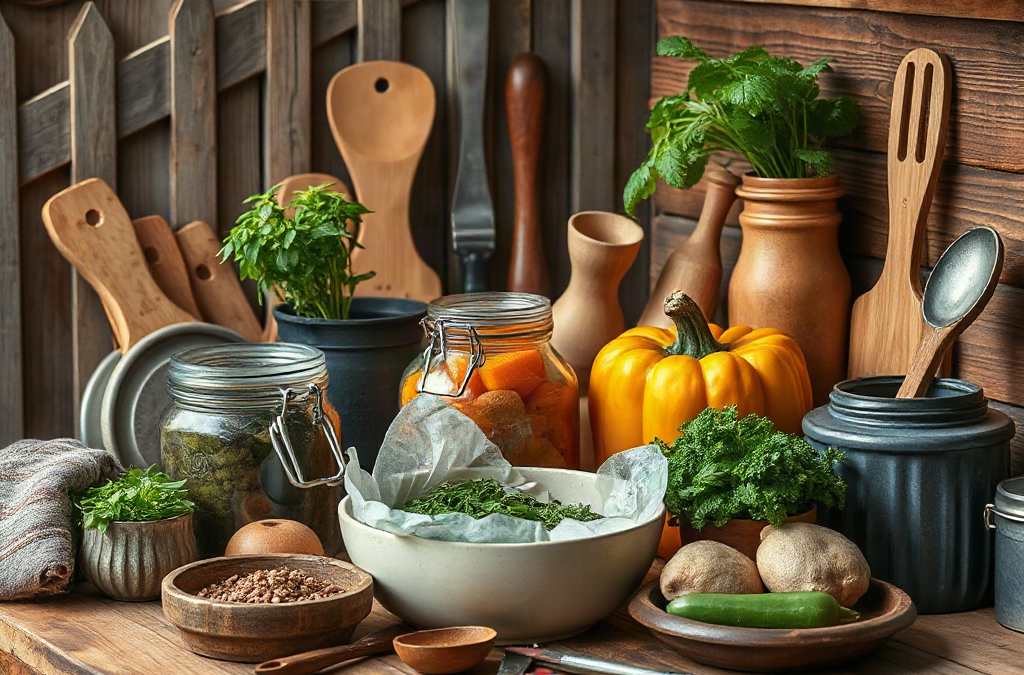
Everyday homesteading turns practical household production into a repeatable system for growing food, preserving seasonal surplus, repairing useful items, and cycling kitchen or yard materials back into production. The most reliable approach is to choose a few outputs your household regularly uses, match them to available time and storage, and track whether each activity saves money or reduces waste. A small herb bed, weekly bread routine, compost system, and basic mending kit usually offer more dependable value than several unfinished projects. Production should expand only after the household can manage harvest timing, food safety, maintenance, and seasonal workload without creating costly spoilage or burnout.
Define Useful Household Production
Useful production begins with household demand rather than an appealing project. A family that cooks with onions, herbs, eggs, broth, and bread every week has a clear set of possible outputs. Producing decorative gourds or a large quantity of unfamiliar vegetables may demonstrate growing skill, but it does not strengthen the household pantry unless those products are eaten, stored, traded, or given away intentionally.
Start by reviewing what enters the home repeatedly. Grocery receipts, pantry shelves, repair purchases, trash, and unfinished chores reveal where home production could have practical value. Fresh herbs are expensive relative to the small space they occupy, while dry beans are inexpensive to buy and require considerable garden area, shelling time, and storage. The better crop is not automatically the one with the highest yield; it is the one that fits the household’s meals, climate, available space, and labor.
The same test applies beyond food. Sewing on a button, sharpening garden tools, making simple cleaners from appropriate ingredients, line-drying laundry, and maintaining wooden handles all preserve household resources. These tasks are forms of production because they extend the useful life of goods or replace a recurring purchase. By contrast, buying specialized equipment for a process used twice a year may increase expense and storage pressure without producing a meaningful return.
A compact production audit can keep priorities realistic:
- List recurring needs: Identify foods, supplies, and repairs used at least monthly.
- Estimate the full input: Include materials, water, energy, tools, storage, and cleanup.
- Check the timing: Note whether the work arrives during an already busy planting, harvest, school, or employment period.
- Choose one measurable output: Examples include six weeks of salad greens, a season of dried herbs, or repaired work clothes.
- Review the result: Record what was used, wasted, purchased, and postponed.
A common mistake is treating self-sufficiency as the goal of every activity. Complete replacement of purchased goods is rarely necessary. Partial production often works better: grow the perishable greens you use most, buy staple flour in bulk, and repair durable clothing while purchasing items that require industrial materials or advanced skill. This selective approach makes Everyday homesteading: practical household production responsive to actual household needs instead of an expanding collection of chores.
Build a Food System the Household Can Maintain
A productive food system connects planting, harvesting, preparation, and storage before seeds go into the soil. Garden plans often concentrate on bed dimensions and crop varieties while ignoring the hours required to wash produce, prepare meals, preserve excess, and clean equipment. Those downstream tasks determine whether a harvest becomes food or compost.
Choose crops by use frequency and harvest behavior. Cut-and-come-again greens, culinary herbs, bush beans, cherry tomatoes, and summer squash can provide repeated harvests, but they require regular picking. Winter squash, storage onions, dry beans, and potatoes concentrate work into fewer harvest periods and need suitable curing or storage conditions. A household with limited weekday time may prefer storage crops, while someone who cooks daily may gain more from frequent fresh harvests.
Succession planting can moderate both abundance and labor. Instead of sowing an entire packet of radishes or lettuce at once, plant a short row and repeat after an interval suited to the crop and local conditions. This produces smaller harvests that are easier to eat. Production is working when meals absorb the harvest naturally, the refrigerator is not crowded with aging produce, and preservation sessions can be scheduled rather than performed as emergency rescues.
Preservation should match eating habits. Freezing is convenient for berries, chopped peppers, prepared tomato products, and blanched vegetables when freezer capacity and reliable power are available. Dehydration reduces storage volume for herbs and some produce but changes texture and may require long drying times. Canning can create shelf-stable foods, yet tested recipes, correct equipment, and careful processing are necessary. Low-acid foods require pressure canning rather than improvisation; official extension and government food-preservation guidance should govern the method.
Consider a household harvesting several baskets of tomatoes in one week. Turning all of them into sauce may consume an entire evening plus cooking fuel and jars. A more balanced plan might reserve sound tomatoes for meals, freeze a measured amount, prepare one tested batch of sauce, and share the remainder while quality is high. The alternative—planting fewer tomatoes and more storage onions—may deliver greater practical value the following season.
Warning signs include skipped harvests, produce spoiling before preparation, freezer contents without dates, and preserved foods nobody wants to eat. Reduce planting volume or narrow the crop list when these patterns recur. Add production only after the existing harvest has a clear destination, safe storage method, and place in ordinary meals.
Turn Waste Streams Into Productive Inputs
Resource cycling works when a household converts a predictable by-product into a safe, useful input without creating a larger management problem. Vegetable trimmings may feed a compost pile, fallen leaves can become mulch, clean glass jars can organize dry goods, and worn cotton fabric may become cleaning cloths. Each cycle reduces disposal or purchasing, but only if the recovered material has a defined use.
Composting is the most familiar example. A functioning pile needs a workable mix of moist, nitrogen-rich materials such as fresh plant scraps and drier, carbon-rich materials such as fallen leaves or shredded plain cardboard. Air and moisture allow decomposer activity to continue. A soggy, compacted pile may smell because air cannot move through it; a very dry pile may change little because biological activity slows. Chopping bulky material, mixing in dry browns, and turning or loosening compacted sections can restore useful conditions.
Not every household needs a large pile. A lidded tumbler or enclosed bin may suit a small lot where neatness and animal exclusion matter. An open pile can handle more leaves and garden residue but needs sufficient space and responsible placement. Local rules may affect composting, livestock, graywater, rainwater collection, or outdoor structures, so resource cycling should not assume that every method is permitted everywhere.
Kitchen scraps should not become an excuse to tolerate pests. Meat, grease, dairy products, and cooked foods can attract animals in many basic backyard systems. Diseased plants, persistent weed seeds, or material exposed to contaminants may also be unsuitable for a home pile. When the output will be used around food crops, careful input selection matters more than maximizing the volume diverted from the trash.

Reuse requires similar judgment. A jar that safely stores dry beans is not automatically suitable for heat processing. Salvaged lumber may work for a tool rack but could contain coatings or treatments that make it a poor choice near soil or food. Reclaimed containers need to be food-safe if they will touch drinking water or produce. The label “reused” does not remove material risks.
Signs of a productive cycle are concrete: compost becomes dark and crumbly, mulch suppresses weeds without smothering plant stems, and saved materials are used within a reasonable period. Growing piles of jars, lumber, and fabric with no assigned project are stored waste rather than productive inventory. Set space limits and discard or recycle materials that exceed them. That boundary keeps Everyday homesteading: practical household production orderly enough to continue.
Balance Savings, Labor, Storage, and Risk
Household production should be evaluated by net usefulness, not by the retail price of the finished item alone. A loaf of bread may cost less in ingredients than a bakery loaf, but the comparison changes after accounting for equipment, energy, failed batches, and time. Homegrown eggs may provide freshness and manure for compost, yet feed, secure housing, health care, local restrictions, and daily animal care continue whether egg production is high or low.
Track a project for one full production cycle. Record purchases, consumable supplies, approximate hands-on time, output, and losses. There is no need to assign a wage to every household minute if the activity is enjoyable, but time still affects feasibility. Two hours spent preserving beans may be reasonable on a quiet weekend and impossible during a peak work period. The ledger should support decisions rather than turn domestic work into constant accounting.
Storage is frequently the hidden limit. A productive garden needs refrigerator, freezer, pantry, cellar, or shelf space appropriate to its harvest. Bulk grain purchases need sealed containers and protection from moisture and pests. Tools need dry, accessible storage so they remain usable. Before increasing output, identify where the finished goods will go and what other items will be displaced. A full freezer without an inventory can conceal food until its quality declines.
Risk should shape the order in which skills are adopted. Low-risk activities include growing herbs, mending fabric, making garden compost from suitable inputs, and air-drying laundry. Food preservation, livestock care, chainsaw work, electrical repair, structural changes, and water systems carry higher consequences when done incorrectly. These activities may require tested procedures, protective equipment, permits, professional help, or local instruction. Confidence gained from simple projects is not a substitute for technical competence in a different task.
A practical monthly rhythm keeps the workload visible. Select one production task, one maintenance task, and one storage check. A spring month might include sowing salad greens, oiling tool handles, and inventorying empty freezer space. Late summer might shift to freezing peppers, repairing a gate latch, and checking jars or dry goods for damage. When chores repeatedly spill into the next month, reduce the production goal before purchasing more equipment.
Success appears as steady use: fewer emergency grocery trips for targeted foods, less spoilage, tools that remain functional, and routines that survive busy weeks. Failure appears as deferred maintenance, unsafe shortcuts, crowded storage, and resentment toward daily obligations. Scaling down is a sound production decision when it protects quality and continuity.
Frequently Asked Questions
What is the easiest household production project to start?
Choose one frequently used product with low safety risk, such as culinary herbs, salad greens, simple bread, compost, or clothing repair. Use what you already own and measure whether the output is consumed or used.
Can everyday homesteading work in an apartment?
Yes. Container herbs, sprouts produced with safe handling, freezer meal preparation, mending, tool care, and careful pantry management do not require acreage. Lease terms, light, ventilation, and storage remain practical limits.
Does producing food at home always save money?
No. Savings depend on input prices, yield, equipment, losses, and whether the household uses the result. High-use herbs and premium produce may offer better value than inexpensive commodity staples.
How many projects should a beginner manage at once?
One or two new routines are usually enough to reveal the true workload. Add another project only after harvesting, cleanup, storage, and maintenance fit comfortably into an ordinary week.
How can I tell whether a homestead routine is failing?
Repeated spoilage, pest problems, unlabeled stored food, neglected maintenance, mounting supply costs, and unfinished work are clear warnings. Reduce volume, simplify the process, or stop the least useful activity.
Conclusion
A durable household production plan is built around goods the household already consumes, realistic labor, safe methods, and enough storage for the finished output. Audit recurring purchases first, then select a modest food, repair, or resource-cycling project with a measurable result. Follow the product through its entire cycle: inputs, daily care, harvest or completion, cleanup, storage, and actual use.
Review the result before expanding. Keep routines that reduce waste, preserve useful goods, or supply food without displacing more urgent work. Adjust crops that arrive faster than the kitchen can handle, limit recovered materials that have no assigned purpose, and seek tested instructions or qualified help for higher-risk tasks. The next useful step is not a larger project; it is making one current routine dependable through a full season.


