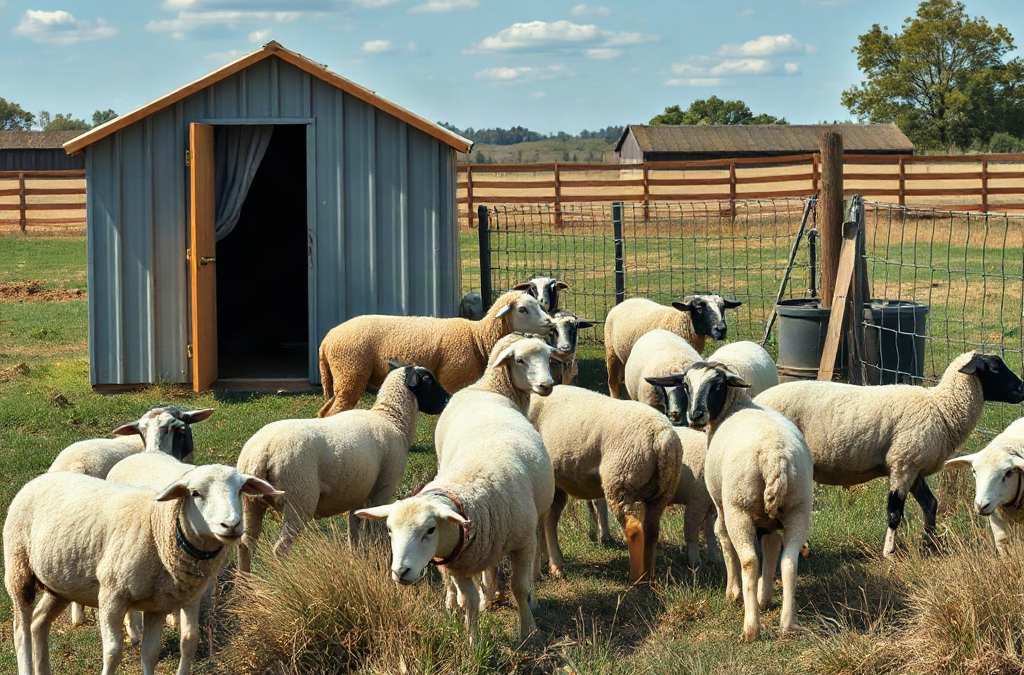
Sheep farming for beginners succeeds when shelter, pasture, and parasite control are managed as one system rather than separate chores. Sheep need a dry, draft-protected resting area, secure fencing, clean water, and enough forage to avoid grazing plants down to the soil. Rotating paddocks and protecting residual grass reduce repeated exposure to infective parasite larvae, but rotation alone does not replace fecal testing or individual health checks. Monitor body condition, eyelid color, manure consistency, appetite, and weight gain, then work with a veterinarian on selective deworming.
What you’ll learn
This guide covers the following practical points:
- Planning a Manageable Starter Flock — A beginner flock should be sized around usable forage, winter feed storage, fencing, and handling capacity—not the total acreage shown on a property map.
- Building Dry, Safe Sheep Shelter — Effective sheep shelter keeps bedding dry, blocks harsh wind, provides ventilation, and allows every animal to enter without crowding.
- Managing Pasture and Grazing Pressure — Pasture management must preserve both forage growth and distance between sheep and parasite larvae near the soil surface.
- Controlling Internal Parasites — Internal parasite control should combine grazing decisions, individual observation, diagnostic testing, and veterinary-directed treatment.
Planning a Manageable Starter Flock
A beginner flock should be sized around usable forage, winter feed storage, fencing, and handling capacity—not the total acreage shown on a property map. Woods, saturated ground, steep banks, lanes, and sacrifice areas may contribute little grazing. Before buying sheep, identify where they will graze, where they will go when the soil is wet, how hay will reach them in winter, and where an animal can be safely examined.
Sheep are social animals, so keeping a lone animal is generally unsuitable. A small group can be easier to observe and handle, but even a few sheep can damage a paddock quickly if forage is scarce. Stocking capacity changes with soil fertility, rainfall, plant species, season, and management intensity; an acreage-per-sheep rule cannot account for those differences. Start below the land’s apparent maximum and record how long each paddock supplies adequate forage.
Choose animals suited to the farm’s purpose and local conditions. Hair sheep avoid annual shearing but still need hoof care, nutrition, fencing, and parasite monitoring. Wool breeds produce a fleece that must be shorn and handled appropriately. Pregnant ewes, growing lambs, and lactating ewes carry greater nutritional and health-management demands than mature nonbreeding animals.
A frequent beginner mistake is purchasing livestock before preparing quarantine space and a handling pen. New arrivals may introduce resistant parasites, foot problems, or contagious disease. Keep them separate from the resident flock, arrange veterinary guidance on an appropriate arrival protocol, and verify that gates, feeders, and fences work before unloading.
Building Dry, Safe Sheep Shelter
Effective sheep shelter keeps bedding dry, blocks harsh wind, provides ventilation, and allows every animal to enter without crowding. Oklahoma State University Extension notes that an expensive barn is not necessary for starting a sheep enterprise. A sound three-sided shed may be adequate in many settings when its opening is oriented away from prevailing storms and the site drains well.
Moisture is often more troublesome than cold alone. Roof leaks, wet bedding, condensation, and mud increase hoof and respiratory concerns while making routine observation harder. Ventilation openings should release humid air above sheep level without creating a direct draft across resting animals. Place the structure on firm, elevated ground and direct roof runoff away from entrances, hay storage, and water points.
Interior layout matters during feeding and lambing. Narrow doorways can trap timid sheep behind dominant animals, while protruding wire, sharp fasteners, and gaps can catch wool, legs, or ear tags. Feeders should limit animals from standing in hay and contaminating it. Water containers need stable footing and frequent cleaning because spilled water quickly creates saturated bedding.
Use a separate dry lot or sacrifice area when grazing would damage wet pasture. Its surface still requires drainage and manure management; confinement on deep mud is not a pasture solution. Inspect shelter with this short priority list:
- Dryness: Check the roof, bedding pack, doorway, and runoff after rain.
- Airflow: Look for condensation or ammonia odor without exposing sheep to direct drafts.
- Access: Provide safe entry, an escape route, and room around feed and water.
- Handling: Include a small catching area where one sheep can be examined without chasing the flock.
Managing Pasture and Grazing Pressure
Pasture management must preserve both forage growth and distance between sheep and parasite larvae near the soil surface. Portable electric netting or subdivided permanent fencing can create multiple paddocks, but rotation is useful only when movement is based on forage condition and contamination risk. Moving animals through tiny paddocks and returning too soon may simply expose them to the same developing parasite population.
Do not treat a fixed rotation calendar as universally safe. Cornell’s pasture-parasite guidance describes faster moves under warm, wet conditions and advises moving when forage falls below three inches. Those thresholds illustrate how weather and grazing height affect risk, but local forage growth, flock vulnerability, and veterinary advice should shape the actual schedule. Leave enough residual leaf area for plants to recover and avoid forcing sheep to eat close to manure.
| Pasture signal | What it may mean | Practical response |
|---|---|---|
| Forage becoming very short | Reduced intake and greater contact with lower plant layers | Move the flock, supply appropriate feed, or reduce stocking pressure |
| Repeated grazing before regrowth | Plants are losing vigor and paddock rest is too short | Add rest days, enlarge the grazing area, or use a sacrifice lot |
| Heavy manure concentration | Uneven use around shade, gates, water, or feeders | Relocate movable resources and avoid grazing contaminated patches tightly |
| Forage consistently left mature | Plants may be unpalatable or paddocks may be too large | Investigate weeds, soil conditions, and selective grazing before mowing |
Rest periods do not automatically make a contaminated paddock safe. Temperature, moisture, plant cover, and parasite species influence survival. Haying can interrupt grazing and expose the remaining canopy and ground to drying and ultraviolet light, an approach discussed by Ohio State University Extension, but it should be treated as one management tool rather than guaranteed sanitation.
Beginners also underestimate fencing pressure. Sheep test gaps when forage is poor or when attractive plants are visible outside the paddock. Train animals to electric fencing in a secure enclosure, maintain voltage, control vegetation touching the wires, and provide a dependable perimeter barrier appropriate to local predators.
Controlling Internal Parasites
Internal parasite control should combine grazing decisions, individual observation, diagnostic testing, and veterinary-directed treatment. Gastrointestinal worms can reduce appetite, growth, and body condition; some may contribute to anemia or swelling under the jaw. Diarrhea can occur for several reasons, however, and normal-looking manure does not prove that parasite burdens are harmless.

Check sheep closely rather than judging the flock from a distance. Compare body condition over time, note animals that lag behind, inspect mucous membrane color with proper training, and investigate reduced feed intake, weakness, persistent scouring, or unexplained weight loss. Pale eyelids, collapse, severe lethargy, or breathing difficulty warrant prompt veterinary attention rather than a wait-and-see approach.
Fecal egg counts can help a veterinarian or diagnostic laboratory assess shedding and evaluate whether a dewormer is working. Results require interpretation because egg output varies by parasite, season, host immunity, and timing. A sample is not a complete diagnosis, and a low count should not override serious clinical signs.
Routine whole-flock deworming on fixed dates is a weak long-term plan. Repeated exposure to the same drug class can select for resistant worms, leaving fewer effective treatment options. Selective treatment aims to treat animals that need it while retaining a population of drug-susceptible parasites in refugia. The drug, dose, route, withdrawal requirements, and follow-up testing should be established with a veterinarian familiar with small ruminants and the farm’s history.
Pasture rotation cannot compensate for bringing untreated risk onto the farm. Quarantine newcomers, obtain fecal testing, and discuss a targeted protocol before allowing them onto shared ground. Record identification, clinical signs, laboratory results, product used, dose, date, and response. A sheep that repeatedly struggles despite sound management may need closer diagnostic evaluation or removal from the breeding flock.
Daily and Seasonal Management Checklist
Consistent observation catches changes before they become flock-wide problems. Watch sheep before entering the paddock: healthy flock behavior, alertness, movement toward feed, and rumination provide a useful baseline. Once animals gather around a person, subtle lameness or isolation may be harder to notice.
- Daily: Confirm every sheep is present, upright, moving normally, and able to reach clean water. Check fences, shelter conditions, appetite, and unusual manure.
- At each paddock move: Record entry and exit dates, estimate residual forage, inspect water access, and note manure concentration or muddy traffic areas.
- Regularly: Handle individual sheep to assess body condition, feet, wool or hair coat, eyelids, and identification. Observation frequency should increase for lambs, late-gestation ewes, and animals with prior problems.
- Seasonally: Arrange shearing where required, review winter hay supply, service fencing, plan breeding and lambing areas, and reassess the parasite program with testing.
Records reveal patterns that memory misses. If body condition falls each time sheep enter one field, investigate forage quality, grazing height, and parasite exposure there. If a drug appears ineffective, do not immediately redose or switch products without guidance; verify dosing accuracy, animal weight, administration technique, and treatment response with a veterinarian.
The main failure mode is allowing routine chores to replace deliberate assessment. Filling a feeder does not confirm that timid sheep ate, and opening a new paddock does not confirm sufficient forage. Look for measurable signs: stable body condition, vigorous forage regrowth, dry bedding, normal flock behavior, and diagnostic evidence that the control program remains effective.
Frequently Asked Questions
How much shelter do sheep need?
Provide enough dry, ventilated space for every sheep to lie down and enter without crowding. Exact space needs vary with animal size, climate, lambing status, bedding system, and time spent confined.
Can sheep live on pasture alone?
Good pasture may meet some classes of sheep during productive seasons, but needs change with forage quality, growth, pregnancy, lactation, and winter conditions. Supply clean water and appropriate minerals, and assess hay or supplemental feed with qualified local guidance.
How often should sheep be moved to fresh pasture?
Move them according to forage height, regrowth, weather, stocking pressure, and parasite risk rather than a rigid calendar. Warm, wet conditions can require faster movement, while each grazed paddock needs adequate recovery before sheep return.
Should beginners deworm sheep on a schedule?
Fixed calendar treatment is generally a poor substitute for individual assessment and fecal testing. Work with a veterinarian to select animals for treatment, choose an effective product, calculate dosing, and check whether treatment worked.
What are warning signs of a serious parasite problem?
Concerning signs include pale eyelids, declining body condition, weakness, poor growth, reduced appetite, persistent diarrhea, or swelling beneath the jaw. Because other conditions can look similar, seek veterinary assessment instead of diagnosing from one sign.
Conclusion
Begin with fewer sheep than the land appears able to carry, then use records to match flock size to actual forage production. Prioritize a dry, ventilated shelter, reliable perimeter fencing, clean water, and paddock moves that protect residual grass. Pair those practices with hands-on body-condition checks, quarantine for new arrivals, fecal testing, and veterinary-directed selective treatment. Before purchasing animals, prepare the handling area, winter-feed plan, sacrifice lot, and health contacts that will be difficult to improvise during bad weather or illness.