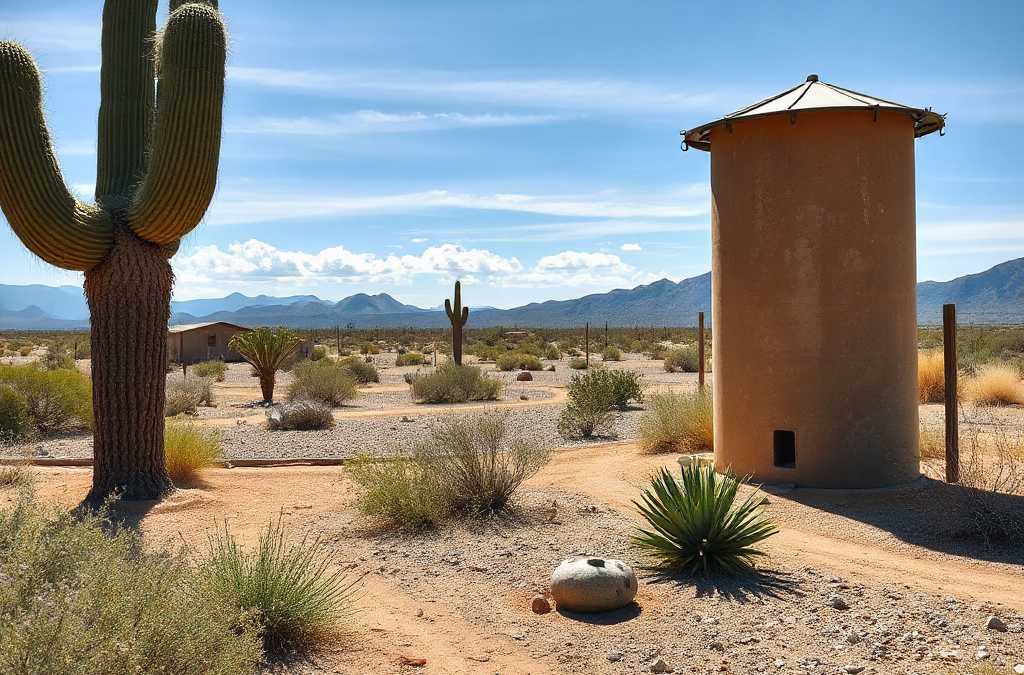
Arizona homesteading succeeds when water planning and heat management are designed as one operating system rather than treated as separate seasonal problems. Verify the parcel’s legal and physical water supply, calculate peak summer demand, provide covered storage, and reserve capacity for outages or delivery delays. Reduce demand with shade, drip irrigation, mulch, drought-adapted crops, nighttime watering, insulated plumbing, and livestock cooling that does not waste water. Test pumps, valves, troughs, and backup power before extreme heat arrives, because a marginal well or exposed line can become an emergency when temperatures and animal consumption rise together.
Verify the Parcel’s Water Reality
A parcel is only as workable as its dependable water source, and a seller’s description is not enough to establish dependability. Arizona properties may rely on a private well, a shared well, hauled water, a municipal connection, or some combination of these. Each arrangement creates different limits involving access, pumping equipment, recurring cost, storage, and interruption risk. Before buying or expanding production, obtain source-specific records and verify what physically serves the property.
For a private well, useful questions include the well’s documented depth, construction, pump configuration, electrical requirements, recent performance, and water-quality history. A well log describes construction at a point in time; it does not promise a particular future yield. Pumping conditions can change, and neighboring wells do not establish what one parcel will produce. A qualified well professional can help assess equipment and conduct appropriate testing. Laboratory analysis is preferable to judging water by taste, odor, or clarity, especially when the water will serve a household, dairy animals, or food preparation.
Shared wells require a different investigation. Read the recorded agreement rather than relying on an informal explanation. Determine who owns the well parcel and equipment, how electricity and repairs are divided, whether use is metered, what happens after a pump failure, and whether the agreement addresses additional homes or livestock. A low monthly charge can conceal weak reserve funding or unclear responsibility for a major replacement.
Hauled water avoids dependence on a private well but shifts the constraint to transportation and stored volume. Confirm where water can actually be obtained, whether the intended vehicle can carry the load safely, and whether delivery trucks can reach the tank during monsoon damage, road closures, or muddy conditions. Water is heavy, so trailer and vehicle ratings matter; an improvised hauling setup can create a road-safety problem long before it solves a supply problem.
Legal availability and physical availability are separate questions. Arizona water rules vary by location and supply type, so prospective owners should consult the Arizona Department of Water Resources and relevant county or local offices before assuming a well may be drilled or expanded. The first priority in Arizona homesteading: water planning and heat management is therefore documentary verification: identify the source, confirm lawful access, inspect the infrastructure, test quality, and price the weakest component. The common failure is budgeting for acreage and buildings while treating water as an inexpensive utility that will simply be present.
Build a Peak-Summer Water Budget
A useful water budget is based on the hottest operating period, not an annual average. Household use, livestock drinking, evaporative cooling, garden irrigation, cleaning, and losses can all rise during summer. The calculation should separate essential demand from discretionary demand so the household knows what must continue if the well slows, a delivery is late, or pumping power fails.
Start by measuring existing use whenever possible. A meter on the main supply, individual branch meters, tank-level records, or dated delivery receipts reveal more than a generic consumption estimate. Track ordinary household demand separately from irrigation and animal systems. Then note changing conditions: the number and type of animals, irrigated square footage, crop stage, soil texture, shade coverage, and the amount lost through leaks or open troughs. Young trees establishing roots may need different scheduling than mature native plants, while shallow raised beds usually dry faster than in-ground beds protected by mulch.
Livestock demand deserves a margin because heat, body size, feed, lactation, and water temperature affect consumption. Do not use a single internet figure as a guaranteed allowance. Obtain species-appropriate guidance from a veterinarian or Arizona Cooperative Extension, observe actual trough use, and keep enough flow available for the whole group to drink. A trough that eventually refills may still be undersized if dominant animals empty it during a hot afternoon.
Garden planning should begin with an irrigation zone rather than a long crop wish list. For example, a household using hauled water may choose one intensively managed bed near the tank, drip lines under mulch, and a separate valve for young fruit trees. That arrangement is easier to measure and shut down than scattered hoses serving multiple distant plots. Flooding a bed can be appropriate in a carefully designed basin, but uncontrolled surface watering commonly loses water beyond the active root zone or to evaporation and runoff.
Use a compact priority calculation:
- Record essential daily use: drinking, sanitation, food preparation, and current animal demand.
- Add production demand: measured irrigation, wash water, and cooling-system use during hot weather.
- Account for system losses: leaks, tank overflow, filter flushing, and water stranded below an outlet.
- Set an interruption period: choose a reserve based on realistic repair, delivery, and power-restoration times for the site.
The budget is working when measured tank levels and meter readings stay within the expected range during heat. It is failing when the pump runs longer, trough recovery slows, pressure changes, deliveries become more frequent, or emergency reserves are repeatedly used for routine irrigation. Recalculate after adding animals, planting trees, changing occupancy, or installing evaporative cooling; yesterday’s surplus can disappear after one expansion.
Design Storage, Distribution, and Backup Capacity
Storage should cover a credible interruption while protecting water quality and preserving usable pressure. One large tank offers simple capacity, but multiple isolated tanks can provide redundancy if a fitting cracks or contamination affects one vessel. The better choice depends on access, budget, fire exposure, freeze risk at elevation, and whether gravity can supply any fixtures when the pump is unavailable.
Place potable-water tanks on a stable base and use materials intended for the application. Opaque, covered storage limits sunlight and debris, while screened vents and protected openings reduce pest entry. Tank location also affects maintenance: a vessel wedged behind a building may be difficult to inspect, clean, or reach with a delivery hose. At higher elevations, exposed valves and shallow pipes need freeze protection; in low-desert heat, sun-exposed pipes can deliver extremely hot water and age prematurely.
Distribution is often the hidden weak point. Long, undersized lines lose pressure, especially when a house, irrigation zone, and livestock trough draw simultaneously. Burying or insulating suitable pipe protects it from solar heating and physical damage, but underground work should include mapped routes and accessible shutoffs. Divide the system so a broken garden lateral can be isolated without cutting water to the dwelling or animals. Label valves and keep compatible repair fittings where they can be found after dark.
A practical configuration might use a source tank, a pressure pump, filtration appropriate to tested water conditions, and separate branches for domestic, irrigation, and livestock use. A float valve at a trough saves labor, yet it also creates an unattended failure point. Add an upstream shutoff, inspect the float, and arrange overflow so leaked water does not undermine fencing or create mud around hooves. Wireless tank monitors can be helpful, but a visible gauge and manual inspection remain valuable when batteries, sensors, or connectivity fail.
Backup power must be matched to the pump’s actual starting and running requirements. A small portable power source that operates lights may not start a deep-well pump. Have an electrician or pump professional identify voltage, starting load, connection method, and safe operating procedure. Gravity storage can maintain limited service without powering every circuit, but elevation determines pressure and may not support ordinary fixtures.
The costly misconception is that nominal tank size equals usable reserve. Outlet position, sediment space, pump protection, and the minimum level needed to maintain suction can reduce accessible volume. Test the system by shutting off the primary source under controlled conditions and operating only essential loads. A sound design supplies drinking water and animal troughs without requiring someone to invent a valve sequence during a heat emergency.
Control Heat Around Homes, Gardens, and Livestock
Heat management works best when it reduces solar gain before consuming additional water or electricity. Shade, orientation, ventilation, insulation, reflective surfaces, and thermal mass can lower the load placed on mechanical cooling. Water-intensive cooling may still have a role, but it should not be the first response on a property with a constrained well or hauled supply.
For the dwelling, inspect west-facing windows, attic insulation, roof condition, duct location, and air leakage. Exterior shade stops sunlight before it passes through glass; an interior curtain mainly manages heat after it enters. Shade structures must be designed for wind and should not block necessary airflow. Night ventilation can be useful when outdoor temperatures fall below indoor temperatures, whereas opening a house during hotter daytime hours adds heat and dust. Mechanical systems need clean filters, unobstructed outdoor equipment, and service before peak demand, not after cooling performance collapses.
Evaporative coolers exchange water for cooling and work differently as humidity changes. Their operation should be included in the water budget, including bleed-off or maintenance water where applicable. Air conditioning generally uses less site water but requires dependable electricity and adequate equipment. Neither option substitutes for reducing heat gain. A poorly shaded, leaky structure forces either system to work harder.

Garden heat protection should focus on the root zone and afternoon exposure. Drip irrigation beneath organic mulch places water near roots and slows surface evaporation. Irrigating during cooler hours reduces immediate evaporative loss, but the schedule should still be adjusted by soil moisture rather than the clock alone. Sandy soil drains quickly and may need shorter applications; heavier soil accepts water more slowly and can remain saturated if emitters run too long. Shade cloth can protect vulnerable crops, although overly dense fabric may reduce flowering or trap heat when installed without airflow.
Animals require species-appropriate shade, ventilation, cool accessible drinking water, and observation during the hottest part of the day. Metal shelters without insulation or airflow can become hotter than open shade. Misters may cool effectively in some low-humidity settings, but they consume water, can produce mud, and become less useful as humidity rises. Fans avoid direct water consumption but add electrical dependence and may be ineffective if they only move very hot air through an enclosed structure.
Watch behavior rather than trusting the presence of equipment. Crowding at one shaded edge, persistent panting, reduced feeding, repeated empty troughs, or animals avoiding a shelter indicate that the arrangement is not meeting demand. Move chores, transport, and handling to cooler hours when practical. The strongest approach combines passive shade with reliable water and a tested backup, a central principle of Arizona homesteading: water planning and heat management.
Run a Pre-Summer Failure Check
A pre-summer inspection should test failures, not merely confirm that equipment operates under light spring demand. Run irrigation while a trough refills and household water is used, then watch pressure, pump cycling, and tank recovery. The goal is to expose competing loads before the hottest week makes every weakness harder to repair.
Trace the full water path from source to endpoint. Look for damp ground, mineral deposits around fittings, chattering valves, damaged insulation, unprotected electrical connections, and overflow marks on tanks or troughs. Clean screens and emitters according to their requirements, exercise shutoff valves, and verify that replacement parts fit. Record normal pressure, pump run time, and overnight tank-level change; these baselines make subtle deterioration easier to recognize.
Next, simulate a power interruption. Confirm which outlets, pumps, fans, and controls remain available, and make sure everyone who may be present understands the safe procedure. Fuel-powered generators must be operated outdoors at a safe distance from occupied structures, following manufacturer instructions. If backup generation cannot run both a well pump and cooling equipment, establish a load priority in advance. Stored drinking water and gravity-fed animal water may allow limited electrical capacity to be directed toward essential cooling.
Inspect shade at the time of day it is needed. A roof that covers a trough in the morning may leave it exposed late in the afternoon as the sun angle changes. Check that anchors, posts, and fabric can tolerate seasonal wind. Clear combustible debris where appropriate without stripping all protective ground cover from garden soil. Irrigation lines should not cross vehicle routes or lie where animals can chew them.
Keep a site-specific response sheet with the well contractor, electrician, water hauler, veterinarian, utility outage contact, valve map, pump specifications, and tank capacities. Include a clear threshold for action, such as calling for delivery when storage reaches a set level rather than waiting for an empty tank. A good check is working when small leaks are repaired, reserve levels remain untouched during routine days, and the system recovers predictably after peak use. Repeated pump cycling, unexplained level loss, hot trough water, or reliance on emergency containers signals that capacity or maintenance needs attention.
The common mistake is buying backup hardware without practicing its use. A generator with stale fuel, a transfer method no one understands, or spare fittings in the wrong diameter offers false confidence. Conduct the test early enough to hire qualified help and obtain parts before regional heat increases service demand.
Frequently Asked Questions
How much stored water should an Arizona homestead keep?
Base storage on measured essential demand and the longest credible interruption in pumping or delivery. Account for unusable tank volume, animal needs, seasonal heat, and repair access rather than choosing capacity from household size alone.
Is a private well more reliable than hauled water?
Not automatically. A well depends on groundwater conditions, pump equipment, electricity, and maintenance, while hauled water depends on vehicles, roads, suppliers, and storage. Compare the complete failure chain for the specific parcel.
When should gardens be watered during Arizona heat?
Cooler hours generally limit immediate evaporation, but soil moisture and root depth should determine duration. Drip lines under mulch usually provide better control than unmeasured overhead watering.
Are misters a good livestock cooling choice?
Misters may help in dry conditions when ventilation is adequate, but they consume water and can create mud. Start with effective shade, airflow, and dependable drinking water, then evaluate misting for the species and site.
What should be tested before Arizona’s hottest weather?
Test source capacity, tank gauges, pumps, valves, trough refill rates, irrigation zones, shade coverage, cooling equipment, and backup power under simultaneous loads. Repair unexplained pressure or storage losses before peak summer demand.
Conclusion
Begin with evidence from the parcel: source records, water testing, measured consumption, soil conditions, and the actual performance of pumps and storage. Use those findings to set a summer budget that protects household and livestock demand before allocating water to optional production. Passive shade, insulation, controlled irrigation, and well-placed ventilation should reduce the cooling load before another water- or power-dependent device is added.
The next step is an operating test. Simulate simultaneous use and a short outage, map every shutoff, confirm usable storage, and establish thresholds for ordering water or calling a repair professional. Revisit the calculation whenever occupancy, animal numbers, planted area, or cooling equipment changes. Arizona conditions leave little room for hidden leaks and untested assumptions, but a measured system makes weaknesses visible while there is still time to correct them.