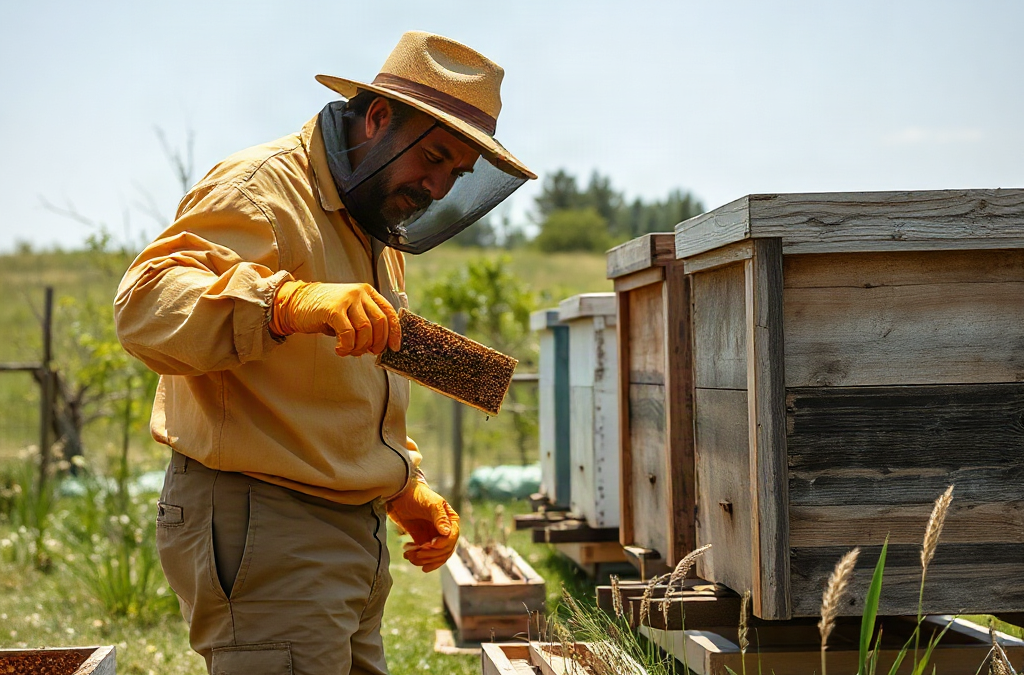
The best beehive for beginners based on handling and climate is usually an eight-frame Langstroth fitted with medium boxes, because its removable frames simplify inspections while lighter boxes reduce lifting strain. Standardized equipment, replacement parts, and local mentoring are also easier to find for Langstroth hives. In cold or windy regions, prioritize adequate stores, a weather-resistant cover, ventilation management, and wind protection; in hot climates, afternoon shade and a dependable water source matter more. A horizontal Langstroth or Layens hive may suit beekeepers who cannot lift stacked boxes, but each requires more permanent yard space and may have less local equipment support.
What you’ll learn
This guide covers the following practical points:
- Compare Beginner Beehive Designs — Hive design determines how frames are inspected, how much weight must be moved, and how readily a new beekeeper can find compatible equipment.
- Choose a Hive You Can Handle Safely — Handling demands should be evaluated with the hive full, not empty on a showroom floor.
- Match the Hive Setup to Your Climate — Climate suitability depends as much on configuration and colony management as on the hive model.
- Buy Compatible Equipment and Plan the Site — Local compatibility often matters more than an unusual hive feature.
Compare Beginner Beehive Designs
Hive design determines how frames are inspected, how much weight must be moved, and how readily a new beekeeper can find compatible equipment. The familiar vertical Langstroth consists of removable frames in stacked boxes. Inspecting the lower brood area may require removing honey-filled boxes first, but standardized dimensions make frames, feeders, covers, and other components comparatively easy to replace.
An eight-frame Langstroth with medium-depth boxes is a practical default when lifting is a concern. It holds fewer frames per box than a ten-frame model, and a medium box is shallower than a deep. Neither choice makes a box harmless to lift: a box packed with honey can still be heavy, especially when it must be raised from an awkward position.
| Hive type | Handling pattern | Climate considerations | Primary tradeoff |
|---|---|---|---|
| Eight-frame Langstroth | Stacked removable boxes; narrower lifts | Adaptable with suitable siting, stores, covers, and ventilation | Boxes may still need to be lifted during inspections |
| Ten-frame Langstroth | Fewer boxes may hold substantial colony space, but each full box is wider and heavier | Widely used across varied climates | Full boxes can exceed a beginner’s comfortable lifting ability |
| Horizontal Langstroth | Frames are accessed at waist height without unstacking supers | Insulation and entrance design must fit local winters and summers | Large footprint and fewer standardized complete-hive options |
| Layens | Deep frames arranged horizontally | Deep combs can consolidate brood and stores, but local management knowledge matters | Heavy individual frames and limited compatibility with Langstroth equipment |
| Top-bar hive | Single combs are lifted from a horizontal body | Comb stability becomes a concern during hot-weather handling | Unsupported comb requires careful manipulation and is harder to exchange with standard apiaries |
Top-bar and Warré hives are sometimes promoted as simpler because they use less conventional equipment. That does not necessarily make them easier to manage. Unsupported top-bar comb can break if tilted incorrectly, while a Warré’s stacked-box management may not match the frame-by-frame inspection practices taught by local mentors. Beginners should treat “natural” or “low intervention” as management philosophies, not evidence that a hive will require less skill.
Choose a Hive You Can Handle Safely
Handling demands should be evaluated with the hive full, not empty on a showroom floor. Honey, bees, comb, and woodenware turn a manageable empty box into a substantial load. The relevant test is whether the beekeeper can raise that load from hive height, carry it briefly, and place it down without twisting or losing control.
Medium boxes throughout the hive simplify inventory because brood and honey frames share one depth. Deep brood boxes reduce the number of brood-box seams, but a full deep is often an unsuitable routine lift for anyone with limited reach, strength, balance, or back mobility. Another option is to remove several frames into a covered transport box before moving the hive body. That takes longer and exposes more of the colony, but it reduces the load handled at one time.
A useful pre-purchase handling check is:
- Measure the working height. Include the stand, bottom board, brood boxes, and likely honey supers.
- Test the reach. Confirm that the top box can be gripped while keeping it close to the body.
- Plan where boxes will rest. Use a stable outer cover, hive stand, or dedicated box rest rather than setting equipment in grass.
- Account for assistance. Do not choose equipment on the assumption that another person will always be available.
A horizontal hive is a credible alternative when lifting boxes is the decisive constraint. Frames can be moved individually along one level, and a roof or lid provides access from above. The compromise is a longer permanent footprint, and very deep frames may themselves become cumbersome when laden with honey. Signs of a good fit include controlled frame movement, an upright working posture, and enough room to set tools down. Repeated overreaching, improvised lifting, or skipped lower-box inspections indicates that the chosen format is working against the beekeeper.
Match the Hive Setup to Your Climate
Climate suitability depends as much on configuration and colony management as on the hive model. Honey bees regulate the nest environment collectively, but poor siting, uncontrolled moisture, inadequate food reserves, or excessive heat exposure can overwhelm that capacity. Buying a hive advertised for a broad climate zone does not replace observing local forage, seasonal winds, humidity, and winter length.
Cold, Wet, and Windy Locations
Cold-climate preparation should keep precipitation out while allowing the colony to manage internal moisture. A sound cover, forward drainage, stable stand, and protection from prevailing wind are more useful than sealing every opening. Condensation management varies with hive construction and local conditions, so insulation, upper ventilation, and moisture-absorbing components should be selected with guidance from experienced nearby beekeepers rather than applied as a universal recipe.
Vertical Langstroth equipment works in cold regions when the colony enters winter with adequate stores and an appropriate cavity arrangement. Horizontal hives may offer insulated walls and avoid breaking apart a tall stack, but a long cavity must still be managed so the colony can reach food. The common mistake is assuming thick walls alone solve winter survival while overlooking food location, pests, colony condition, and water intrusion.
Hot, Humid, or Dry Locations
Hot-weather management centers on reducing avoidable heat load without placing the hive in a damp, stagnant pocket. Morning sun with afternoon shade can be useful in very hot areas, while a reliable water source reduces pressure on neighboring taps, pools, or animal troughs. Good access around the hive remains necessary because vegetation that blocks the entrance or traps humid air makes inspections and airflow harder.

Top-bar comb deserves especially gentle handling during heat because warm, unsupported wax can deform or detach. Keep each bar in its normal vertical plane rather than rotating the comb flat. Excessive ventilation is not automatically better either; changing entrances and screened components can alter the colony’s ability to control airflow and defend the hive. Local seasonal practice should guide those adjustments.
Buy Compatible Equipment and Plan the Site
Local compatibility often matters more than an unusual hive feature. A beekeeper who uses the same frame size as a mentor can more readily obtain spare frames, move brood or food when appropriate, and get relevant help during an inspection. Before purchasing, ask nearby beekeeping associations what hive format and frame depth are commonly used in the area.
Standardization also prevents an expensive early mistake: mixing nominally similar components that do not fit correctly. Choose one frame length and, where practical, one box depth. Confirm that the bottom board, boxes, inner cover, outer cover, feeder, and any pest-management components are designed to work together. Used equipment can reduce cost, but its history and condition should be assessed carefully; damaged comb, failing joints, incompatible dimensions, and disease concerns can outweigh the savings.
For a worked decision comparison, consider two hypothetical beginners. One has moderate lifting ability, limited yard space, and an active local club using Langstroth equipment. Eight-frame medium boxes preserve compatibility while reducing each box’s width and depth. The other beekeeper cannot safely unstack boxes but has room for a long stand. A horizontal Langstroth lets that person inspect individual standard frames without lifting supers, even though the complete hive occupies more ground.
Set the chosen hive on a stable, level stand with room to work behind and beside it. Keep the flight path away from doors, paths, play spaces, and livestock handling areas. Confirm applicable local rules before bees arrive, and arrange protective clothing, a smoker, hive tool, feeder if needed, and a plan for obtaining timely local help. Equipment is suitable only when the beekeeper can inspect the colony consistently throughout the season.
Frequently Asked Questions
Is an eight-frame or ten-frame hive better for a beginner?
An eight-frame Langstroth is often easier to grip and produces narrower box loads. A ten-frame hive may match local equipment more closely, so compare lifting comfort with the parts and mentoring available nearby.
Should a beginner use deep or medium brood boxes?
Medium boxes reduce the load per full box and allow one frame depth throughout the hive. Deeps provide more comb per box but become cumbersome when full, making them less suitable for beekeepers with lifting limitations.
Are horizontal hives easier to inspect?
They eliminate routine super lifting because frames are handled individually at one level. They require more horizontal space, however, and local mentors or replacement components may be harder to find.
Which hive is best for a cold climate?
No single model guarantees cold-weather success. Choose a hive that can be kept dry, protected from wind, and managed for local winter conditions, then seek regional advice on stores, insulation, moisture, and entrance configuration.
Does a beehive need shade in a hot climate?
Afternoon shade may reduce heat exposure in very hot locations, while morning sun can help warm the hive earlier. Preserve airflow, provide nearby water, and avoid deep shade that leaves the site persistently damp.
Conclusion
Base the purchase on the heaviest routine task, the local weather pattern, and the equipment used by nearby beekeepers. Eight-frame medium Langstroth equipment offers a strong balance of manageable components and broad compatibility, while a horizontal format deserves consideration when unstacking boxes is unsafe. Test reach and working height before buying, inspect the proposed site through sun, rain, and wind, and confirm that replacement parts and knowledgeable help will be available after the colony arrives.