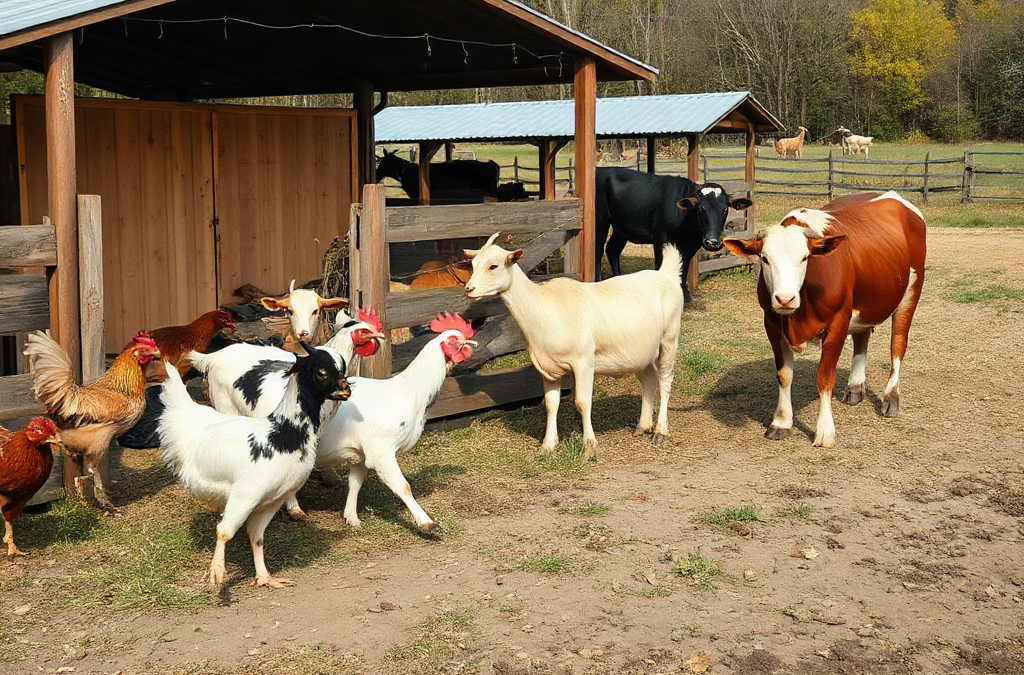
Homesteading livestock should be chosen by workload rather than appeal, with daily feeding, water, fencing, manure, health checks, and seasonal chores matched to the keeper’s available time. Laying hens and meat rabbits usually fit smaller properties and shorter chore windows, while goats, sheep, pigs, and cattle demand progressively stronger infrastructure or more complex handling. Breeding, milking, pasture rotation, and winter feeding can sharply increase labor beyond routine animal care. A practical choice leaves enough capacity for illness, bad weather, vacations, and equipment failures instead of consuming every available hour during normal weeks.
What you’ll learn
This guide covers the following practical points:
- Measure the Full Workload Before Choosing — Livestock labor has three layers: routine chores, periodic jobs, and disruptive events.
- Compare Livestock by Labor Pattern — Species differ less by whether they require work than by when that work occurs and how difficult it is to postpone.
- Account for Seasonal and Hidden Work — Peak workload determines whether a livestock plan remains manageable.
- Use a Capacity-First Selection Process — A capacity-first choice begins with the household’s hardest constraint, not its preferred animal.
Measure the Full Workload Before Choosing
Livestock labor has three layers: routine chores, periodic jobs, and disruptive events. Routine work includes feed, water, observation, egg collection, and opening or securing housing. Periodic jobs include moving fences, trimming hooves, cleaning shelters, transporting feed, maintaining equipment, and arranging breeding or processing. Disruptive events include escaped animals, frozen water, difficult births, predator damage, illness, and storm preparation.
Counting only feeding time produces a misleading estimate. Ten minutes at a feeder does not include carrying bags, repairing a gate, scrubbing containers, buying supplies, or noticing that an animal has stopped eating. Travel matters too. A distant pasture, poorly placed water source, or feed room on the opposite side of the property can turn a short chore into repeated walking and hauling.
Separate fixed labor from labor that grows with herd size. Opening a poultry coop takes nearly the same time for six hens as for twelve, but cleaning, feed use, egg handling, and health observation rise as the flock expands. Larger grazing animals may add relatively little daily feeding work during good pasture conditions, yet each additional animal increases hay storage, manure concentration, handling difficulty, and winter expense.
Use a normal-week audit before selecting a species. Record the time genuinely available every morning and evening, including workdays, weekends, and days with poor weather. Then identify who can cover those chores if the primary keeper is sick or away. A species is not a workable fit when its basic care relies on uninterrupted availability from one person.
Compare Livestock by Labor Pattern
Species differ less by whether they require work than by when that work occurs and how difficult it is to postpone. The table compares common small-farm choices on a qualitative basis. Actual labor changes with climate, stocking density, housing, pasture quality, production goals, and the distance between animals and supplies.
| Livestock | Routine Chore Pattern | Major Workload Pressure | Often Fits |
|---|---|---|---|
| Laying hens | Daily feed, water, collection, and secure housing | Predator protection, bedding, and flock sanitation | Small properties with reliable morning and evening coverage |
| Meat rabbits | Daily feeding, watering, and close observation | Heat management, cage or colony cleaning, and breeding records | Limited acreage where frequent hands-on checks are practical |
| Goats | Daily checks plus forage, water, and mineral management | Fence testing, hoof care, parasite pressure, and kidding | Keepers prepared for active handling and strong fencing |
| Sheep | Regular flock checks with pasture or stored-feed management | Parasites, hoof work, lambing, and wool management for wool breeds | Properties with suitable grazing and flock-handling facilities |
| Pigs | Daily feed, water, observation, and pen inspection | Strong fencing, bedding, rooting damage, mud, and feed movement | Households able to handle concentrated seasonal labor |
| Cattle | Daily observation and water checks; feeding varies by season | Hay, robust facilities, manure, transport, and safe handling | Adequate land, equipment access, and experienced backup help |
Poultry is often considered low-work because individual birds are small. That assumption fails when housing is difficult to clean, water freezes, predators repeatedly test the enclosure, or the flock expands faster than the coop. Rabbits avoid pasture fencing but replace it with frequent attention to ventilation, sanitation, temperature, and individual condition.
Goats and sheep may harvest much of their own feed on appropriate forage, but grazing does not remove labor. Fences must work, animals must be counted and observed, and parasite or hoof problems require timely action. Goats tend to challenge weak enclosures, while sheep can conceal signs of poor condition until a keeper inspects them closely.
Pigs can suit a household seeking a defined production cycle rather than a permanent breeding herd. Their daily routine may be straightforward, but moving feed, maintaining water, managing disturbed ground, and loading finished animals can be physically demanding. Cattle may require fewer close-contact chores than dairy goats under some grazing systems, yet mistakes involve larger animals, heavier equipment, stronger facilities, and more difficult transport. Low chore frequency should not be confused with low consequence.
Account for Seasonal and Hidden Work
Peak workload determines whether a livestock plan remains manageable. A system that feels easy in mild weather can fail during winter feeding, spring births, summer heat, or wet-season mud. Evaluate the busiest month rather than using a pleasant pasture day as the baseline.
Breeding changes the labor category of almost any species. Birth monitoring, newborn checks, separation pens, extra bedding, and possible bottle feeding create time-sensitive duties. Keeping intact males also requires secure separation and deliberate handling. A small breeding group can therefore demand more attention than a larger group of nonbreeding animals.
Milking creates the least flexible schedule. A dairy cow or goat ties the household to regular milking, equipment cleaning, milk cooling, and a plan for offspring. Skipping a session is not equivalent to delaying coop cleaning. Anyone considering dairy animals should first test the schedule by following the proposed morning and evening routine for several weeks without owning the animal.

Feed logistics are another hidden burden. Bagged poultry feed can often be carried by hand, while winter hay for larger stock requires dry storage, repeated movement, and sometimes machinery. Ask where deliveries will unload, whether vehicles can reach the storage area in bad weather, and how feed will travel from storage to the animals. An inexpensive animal can create an expensive handling problem when the property lacks access and storage.
End-of-cycle work also belongs in the decision. Eggs require collection and storage; fiber animals may need shearing arrangements; meat animals require lawful, humane processing and transport plans; aging animals still need care after production declines. A common failure is planning enthusiastically for acquisition while leaving breeding control, veterinary access, processing, and eventual disposition unresolved.
Use a Capacity-First Selection Process
A capacity-first choice begins with the household’s hardest constraint, not its preferred animal. That constraint may be morning time, physical lifting, fence budget, winter water, pasture, noise tolerance, travel frequency, or access to suitable veterinary and processing services. Eliminating incompatible species early prevents costly infrastructure from being built around an unrealistic routine.
- Define the product or service. Decide whether the goal is eggs, meat, milk, fiber, grazing, manure, breeding stock, or companionship.
- Map daily coverage. Assign morning and evening chores to named people and identify a competent substitute.
- Inspect infrastructure gaps. Price the shelter, fence, water delivery, feed storage, handling area, and transport needed before purchasing animals.
- Model the difficult season. Walk through frozen water, stored-feed use, mud, heat, births, and predator pressure.
- Begin below maximum capacity. Leave room for learning, emergencies, repairs, and animals that need individual care.
Consider an illustrative household with a small fenced yard, no tractor, one dependable caretaker, and a job that allows brief chores before and after work. A modest laying flock may fit because feed can be stored in manageable containers and chores can be consolidated near the house. Two dairy goats may not fit even if space appears adequate: milking adds rigid sessions, goats require stronger fencing, and hay, hoof work, breeding, and backup milking all increase operational demands.
Signs of a good match include chores finishing within the planned window, clean water remaining dependable, body condition being observed regularly, bedding and manure staying under control, and repairs being handled before escape or injury occurs. Warning signs include repeatedly missed checks, deferred cleaning, empty feed reserves, overloaded shelters, improvised fencing, and no one willing or able to provide relief care.
Do not expand merely because the current animals feel easy during one season. Complete a full weather cycle, document actual feed and labor demands, and correct weak infrastructure first. A smaller group managed consistently usually provides more usable output than a larger group that overwhelms the property and household.
Frequently Asked Questions
Which homestead livestock usually requires the least daily work?
A small laying flock or group of nonbreeding rabbits often has a manageable daily routine, but neither is maintenance-free. Secure housing, dependable water, sanitation, temperature control, and individual health checks still determine the actual workload.
Are grazing animals less work because they feed themselves?
Pasture can reduce feed handling during the growing season, but it adds fence inspection, forage monitoring, rotation, water placement, and parasite management. Winter or drought may shift the system back to stored feed and heavier daily hauling.
How does breeding affect livestock workload?
Breeding adds recordkeeping, separation, birth monitoring, newborn care, and the possibility of urgent problems. Keeping animals for eggs or seasonal meat without maintaining breeding stock is often simpler for a time-limited household.
Should a new homesteader keep more than one livestock species?
Starting with one species makes it easier to test chore schedules, fencing, feed storage, and backup coverage. Add another only after the first system has remained manageable through its most demanding season.
What should be arranged before buying livestock?
Prepare species-appropriate shelter, fencing, water, feed storage, handling space, transport, emergency contacts, and relief care. Confirm local requirements and the availability of veterinary or processing services relevant to the intended animals.
Conclusion
Choose livestock only after matching its busiest season and least flexible chores to the household’s real capacity. Daily feeding is only part of the commitment; fencing, water, manure, breeding, stored feed, handling, transport, and emergency coverage often decide whether a species is sustainable. Audit available time, identify the limiting resource, prepare infrastructure, and begin with fewer animals than the property could theoretically hold. Expand after one full seasonal cycle shows that care remains timely and backup plans work.