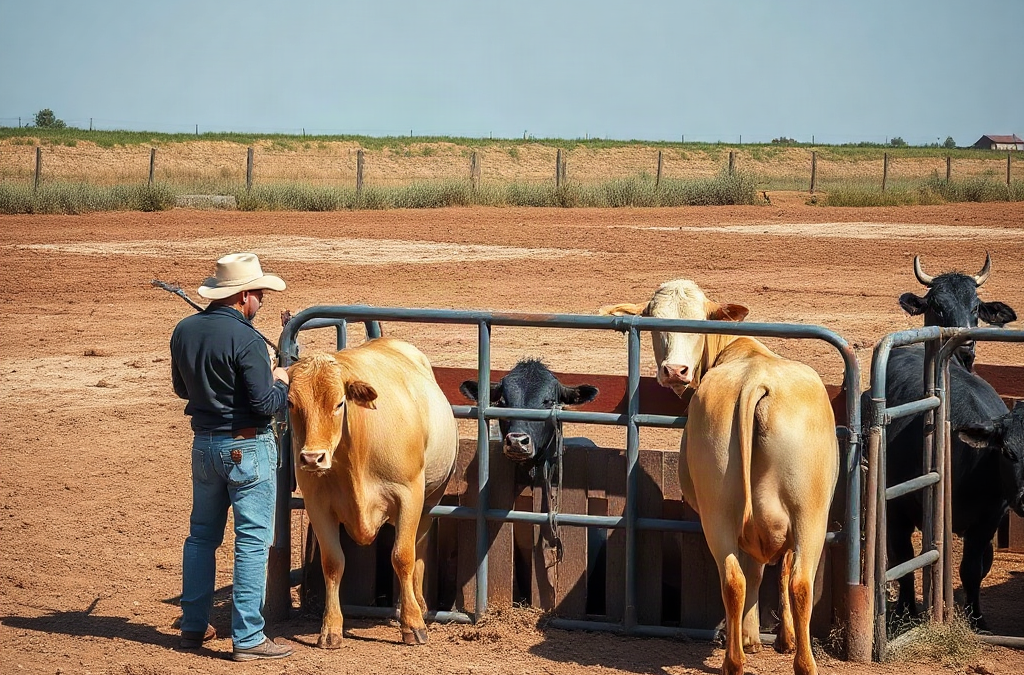
Cattle sorting for beginners is safest when movement and handling rely on calm pressure, clear escape routes, and facilities that keep people outside an animal’s path. Work small groups, approach at an angle near the edge of the flight zone, and release pressure as soon as cattle move correctly. Close gates before changing position, avoid standing in gateways or directly behind an animal, and never enter a confined pen with an agitated bull or cow. Stop when cattle begin slipping, crowding, turning back, or charging gates; those signs indicate that pace, pressure, footing, or pen setup needs correction.
What you’ll learn
This guide covers the following practical points:
- Prepare the Sorting Area Before Moving Cattle — A safe sort begins with the route, gates, and footing rather than with pressure on the herd.
- Use the Flight Zone and Point of Balance — The flight zone is the space around an animal that, when entered, prompts it to move away.
- Sort Cattle One Decision at a Time — Beginners usually gain better control by sorting a few cattle at a time rather than filling the crowd pen.
- Recognize Danger and Know When to Stop — Escalating agitation is a reason to reduce pressure or end the attempt, not to work faster.
Prepare the Sorting Area Before Moving Cattle
A safe sort begins with the route, gates, and footing rather than with pressure on the herd. Walk the intended path while the pens are empty. Remove loose wire, protruding hardware, buckets, and other objects that could catch an animal or handler. Check that every gate swings freely and can be latched from a position that does not place a person in the opening.
Define where each group will finish before bringing cattle into the working area. If calves are going to one pen and cows to another, both destinations should be secure and visibly open from the decision point. A handler who must stop to repair a latch or decide where an animal belongs creates delay, crowding, and conflicting pressure.
Good footing matters at gates, corners, and other places where cattle turn or accelerate. Mud, ice, polished concrete, deep ruts, and abrupt shadows may cause hesitation or loss of footing. Correct what can be corrected, then slow the movement around any unavoidable hazard. More pressure is a poor response to an animal that is looking down or testing uncertain ground.
Before starting, make a compact safety check:
- People: Assign one person to direct movement and agree on simple verbal signals.
- Gates: Set each gate for the planned route and verify the latches.
- Escape: Identify a clear exit for every handler; never depend on climbing a weak fence.
- Occupancy: Keep children, dogs, visitors, and unnecessary helpers away from the pens.
- Animals: Note bulls, recently calved cows, injured cattle, and animals known to challenge people.
A common beginner mistake is adding people when movement becomes difficult. Extra handlers often produce pressure from several directions. One calm handler in the correct position may be more effective than three people filling the animal’s forward path.
Use the Flight Zone and Point of Balance
The flight zone is the space around an animal that, when entered, prompts it to move away. Its size is not fixed. Cattle accustomed to close human contact may tolerate a nearby handler, while less familiar or already excited cattle may react at a greater distance. Watch the animal’s head, feet, and attention rather than assuming one distance works for the entire herd.
The point of balance is commonly near the shoulder. Working behind that point generally encourages forward movement; moving ahead of it tends to slow, stop, or turn the animal. Position also matters across the pen: standing directly in the destination opening can block it, even when the gate appears open to the handler.
Apply pressure by approaching the edge of the flight zone at an angle, not by walking straight at the animal’s tail. When it steps in the intended direction, pause, step away, or soften your angle. That release teaches the animal where relief is available. Constant pressure gives no useful feedback and may send cattle past the gate or back into the group.
For example, if a heifer stops several feet before an open alley, first check whether a person, flapping jacket, strong contrast, or unfamiliar object is occupying her attention. Step out of her line of travel and approach from behind the shoulder. If she advances, release immediately. If she turns to face you with her head high and does not yield space, retreat to safety instead of escalating the encounter.
Sort Cattle One Decision at a Time
Beginners usually gain better control by sorting a few cattle at a time rather than filling the crowd pen. A lightly stocked pen leaves room for animals to turn and for the handler to change position. An overfilled pen removes both options and increases the chance of piling at a gate.
- Bring up a small group. Allow the cattle to settle and face the direction of travel before asking for movement.
- Create a clear lead. Encourage the first animal toward the open route while staying out of the opening.
- Control the gate. Move it smoothly without placing your body between the gate and a post, wall, or animal.
- Separate at the decision point. Apply pressure to the animal being selected while avoiding unnecessary pressure on the animals that should remain.
- Secure each finished group. Latch the destination pen before bringing more cattle forward.
Consider a cow-and-calf separation in a small corral. Rather than pushing the entire pair group toward two partially open gates, move two or three pairs into the sorting pen. Let a cow pass through the forward gate, then direct her calf through the side gate after the cow clears the hinge area. This slower cycle reduces gate congestion and gives the handler time to confirm identification.

Sorting sticks or paddles can extend a handler’s visible presence, but they should not be used to strike or jab cattle. Loud shouting and sudden arm movements may create a short burst of motion, yet that speed is difficult to direct. The useful measure of progress is not how fast cattle run; it is whether they walk through the chosen opening without repeated turnbacks.
Recognize Danger and Know When to Stop
Escalating agitation is a reason to reduce pressure or end the attempt, not to work faster. Warning signs include repeated circling, bunching tightly, crashing into gates, slipping, rapid turnbacks, and sustained attention toward a handler. A single animal that squares up, shakes its head, paws, or advances into a person’s space requires immediate distance and a solid barrier.
Never stand in the arc of a swinging gate, inside a narrow gateway, or between cattle and a fence with no escape. Avoid reaching through rails near an animal’s head, and do not turn your back on cattle in a confined pen. Bulls and protective cows add risk because familiar behavior can change with breeding activity, calves, pain, or crowding. Physical separation and purpose-built handling facilities are preferable to relying on an animal’s usual temperament.
If movement fails, stop and identify the obstruction. Cattle may be reacting to glare, a dangling chain, a person beyond the gate, poor footing, separation from herd mates, or pressure applied from the wrong side. Repositioning one person or opening the receiving pen fully can be more effective than increasing force.
Injured, trapped, or extremely agitated cattle may require a veterinarian, experienced stock handler, or emergency assistance appropriate to the situation. Do not enter a trailer, chute, or damaged enclosure to free an animal unless it can be done without entering its strike, kick, or crush zone. A delayed sort is less costly than an avoidable injury.
Frequently Asked Questions
How many cattle should a beginner sort at once?
Use the smallest group the facility can hold without isolating cattle unnecessarily. Two to five animals may be manageable in a modest pen, but available space, temperament, and gate layout matter more than a fixed number.
Where should I stand to make cattle move forward?
Work near the edge of the flight zone and generally behind the shoulder. Approach at an angle, then step back when the animal advances so pressure does not become continuous.
Why do cattle stop at an open gate?
They may see a person blocking the route, uncertain footing, glare, shadows, moving equipment, or a sharp contrast beyond the gate. Inspect the animal’s sightline before applying more pressure.
Should I use a sorting stick or paddle?
A sorting aid can extend your visual presence and help direct movement from a safer distance. Use it as a positioning tool, not to hit, poke, or provoke cattle.
When should I stop a cattle-sorting session?
Stop when cattle repeatedly slip, pile up, charge gates, challenge handlers, or cannot recover from agitation after pressure is removed. Secure the animals, leave the pen, and correct the setup before trying again.
Conclusion
Effective cattle sorting depends on preparation, position, and timely release of pressure. Set the gates and destinations first, move small groups, and give cattle a visible route without standing in it. Treat slipping, crowding, turnbacks, or confrontational behavior as reasons to pause and change the setup. Beginners should practice with calm cattle and an experienced handler nearby, while reserving bulls, distressed animals, and damaged facilities for people equipped to manage the added risk.